

Every “Christmas diamond painting ideas” list on the internet has the same structure: a grid of pretty designs with no reason to pick one over another.
That’s the wrong frame. Diamond painting Christmas decorations are placement-dependent. A pendant that transforms an entryway looks like clutter on a mantel. A large framed canvas that anchors a living room wall is overwhelming in a hallway.
So this guide is organized the way you actually decorate — room by room. Each section names the space, explains what that space needs from a decoration, and picks specific kits that fit. By the end you’ll have a full-house plan instead of a wishlist.
If you’re still deciding whether diamond painting fits your home at all, our decor ideas collection covers the wider category. This piece assumes you’re already in and just need to place things well.
A quick principle before the room-by-room breakdown, because it explains every pick below.
Three variables decide whether a diamond painting decoration works in a space:
Get those three right and any design works. Get them wrong and the most beautiful kit in the catalog looks like a mistake.
A quick comparison of the three formats:
| Format | Best Placement | Light Requirement | Scale Feel |
|---|---|---|---|
| Framed pearl kits (12×12 in) | Mantel, shelf, gallery wall | Medium — any directed light | Substantial, anchored |
| Hanging pendants / suncatchers | Windows, doorways, tree | High — needs backlight | Delicate, airy |
| Coaster sets | Table, kitchen, bar cart | Low | Functional, tactile |
What the space needs: something at eye level, weather-proof enough for a door area, and small enough not to crowd a console.
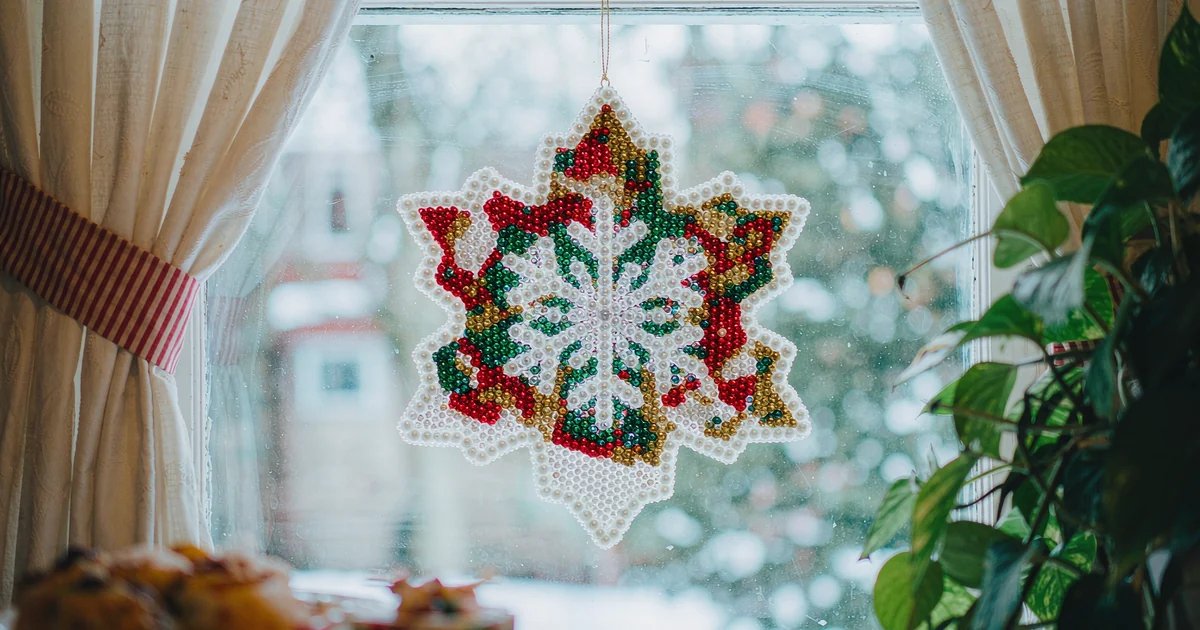
The entryway is where diamond painting decor outperforms almost anything else, because a hanging piece catches light from the door and reads as far more expensive than it is.
Best pick: a circular or snowflake-shaped hanging pendant. The snowflake silhouette is the strongest entryway design because the shape itself is decorative — even from across the room, before you can see the design, it reads as “holiday.”
Placement tip: hang at 60–66 inches from the floor. Higher and it reads as a wall decoration; lower and it competes with whatever’s on your console.
What the space needs: one piece with enough visual weight to hold the mantel together, and horizontal balance with stockings and candles.
This is the only room where scale matters more than anything else. A mantel needs an anchor.
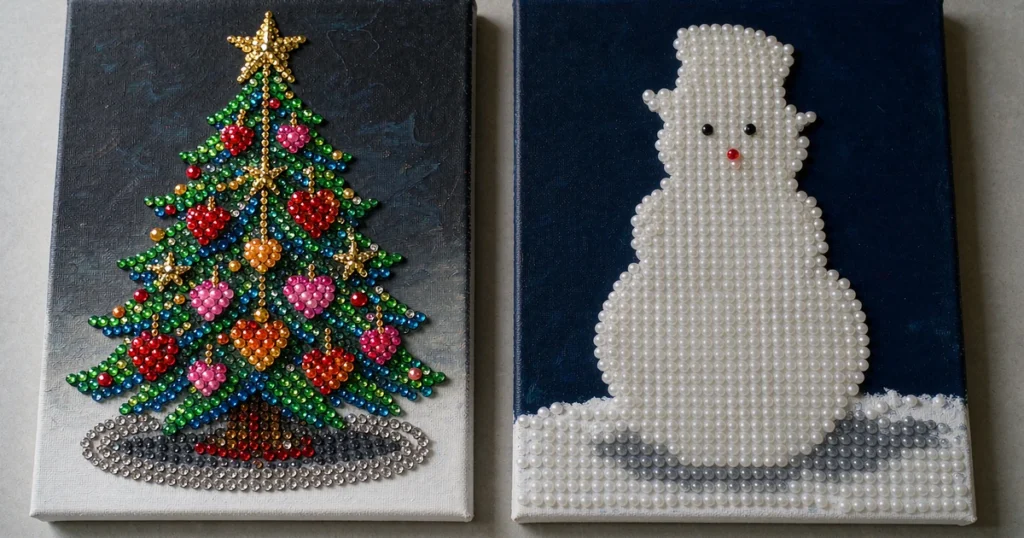
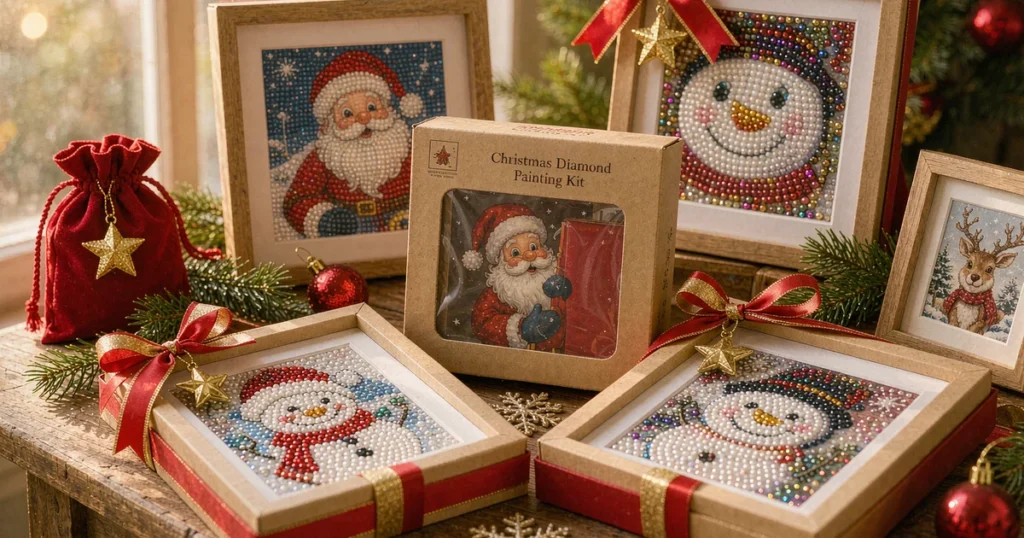
Best pick: a framed 12×12 in pearl kit. Pearls give a softer, more painterly finish than resin drills, which suits a mantel’s warm lighting far better than a glittery mosaic.
Placement tip: if your mantel is wider than 60 inches, pair a framed piece with two hanging pendants flanking it. The mixed-format arrangement fills the width and gives you two light-grabbing elements.
What the space needs: decorations that survive being used. The kitchen is where decorative-only pieces fail.
Best pick: coaster sets. This is the only category of diamond painting decor that improves with handling, and the kitchen is where it belongs.
Placement tip: a 10-piece set covers a full dinner table with one per setting — the closest thing to “theme-matched tableware” a craft kit can give you. Store them in their holder on the table rather than a cupboard; they’ll get used far more.
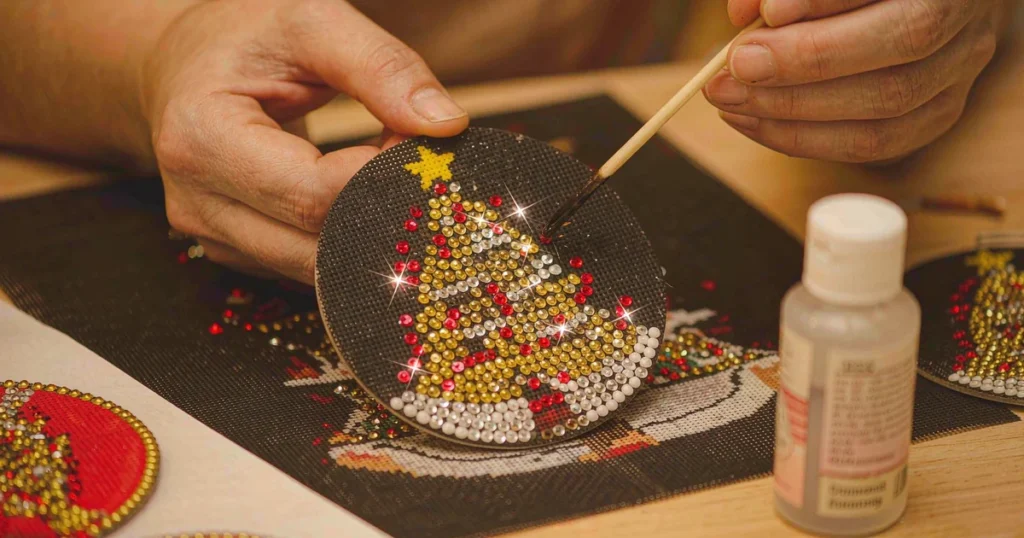
If you’re building these from scratch, our coaster troubleshooting tutorial covers sealing them for actual hot-drink use.
What the space needs: small, light, shatterproof ornaments. The tree is where fragile decor goes to die, which is exactly why diamond painting pendants belong here.
Best pick: small hanging pendants used as ornaments. They’re acrylic-based rather than glass, so a fallen tree branch doesn’t become a cleanup project.
Placement tip: place them near the lights, not in front of them. Backlighting is what makes the beads luminous; a pendant in shadow looks like a plain ornament.
What the space needs: something small, personal, and not overtly festive — a piece that works in the room on December 27 too.
This is the most underrated placement on this list. A guest room is the one space where a general theme beats a Christmas theme.
Placement tip: a small shelf or nightstand, not a wall. Guest rooms don’t have the wall real estate to justify a 12×12 in piece, and a leaning shelf piece is easier to change out.
If you want the complete plan without reading the sections twice:
| Room | Format | Quantity | Primary Placement | Best Kit Type |
|---|---|---|---|---|
| Entryway | Hanging pendant | 1–2 | Doorway / window, 60–66 in | Snowflake or circle shape |
| Living room | Framed kit | 1 (+2 pendants) | Mantel center | Pearl, 12×12 in |
| Kitchen / dining | Coaster set | 1 set | Table, in holder | 6–10 pc themed set |
| Christmas tree | Small pendant | 3–5 | Near lights | Circle / bell designs |
| Guest room | Small framed kit | 1 | Shelf, leaning | Winter or non-seasonal |
That’s five rooms, roughly 8–14 pieces, and a genuinely full-house themed setup — for well under the cost of a single store-bought decor set.
Q: What’s the best Christmas diamond painting for a mantel? A: A framed 12×12 in pearl kit. Pearls suit the warm, soft light of a mantel better than sparkly resin drills, and the frame gives it the visual weight an anchor piece needs.
Q: Can I hang diamond paintings in a window? A: Yes — and for pendants and suncatchers, windows are the best placement. Backlighting is what makes pearl and crystal beads glow. Direct sunlight over years can fade the print, so a bright but indirect window is ideal.
Q: How many pieces do I need to decorate a whole house? A: Roughly 8–14. One framed anchor, one or two pendants per high-traffic doorway, a coaster set for the table, and 3–5 small pendants for the tree.
Q: Are diamond painting decorations durable enough to reuse next year? A: Sealed and stored flat, yes — they’re among the most durable DIY decorations you can make. Store pendants in a box rather than a bag to avoid the chain tangling.
Q: Do these work in a modern or minimalist home? A: Yes, if you keep the palette tight. Choose kits with a limited color range (white, gold, forest green) and avoid dense, busy designs. The snowflake shapes and church design work particularly well in minimal interiors.
Q: What’s the best color palette for Christmas diamond painting decor? A: Forest green, gold, and white is the most flexible — it works in traditional and modern interiors and reads as elegant rather than childish. Red-and-white reads more playful and works better in kitchens and kids’ spaces.
Q: How do I display a finished pendant so it hangs straight? A: Use a small clear hook or a suction cup on glass. The pre-assembled chains on DOTZSO pendants are already balanced; the most common cause of a crooked hang is a hook placed off-center, not the piece itself.
The difference between a decorated home and a home with decorations in it is placement. Work room by room, respect the scale and light rules, and mixed formats — framed anchors plus light-catching pendants — do far more than a wall of same-sized pieces ever will.
Start with the room guests see first, then work inward.
🎄 Shop the full Christmas diamond painting collection or browse crystal art hanging pieces for the pendant-led placements.
Want to see everything the placements come from? The Christmas collection page groups the pieces by room and by display style, so you can build a coordinated set rather than buying one-offs.